





This Book is Out of Stock!
by



Paperback
₹5355
₹6635
19.29% OFF
(All inclusive*)
Delivery Options
*COD & Shipping Charges may apply on certain items.
Review final details at checkout.
Looking to place a bulk order? SUBMIT DETAILS

Piracy-free

Assured Quality

Secure Transactions
About The Book
Description
Author
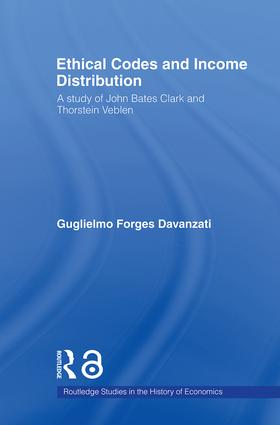
<p>In contemporary non-mainstream economic debate it is widely thought that the functioning of a market economy needs a set of rules (i.e. institutions) which bind agents in their behaviour allowing efficient outcomes. This idea is contrary to the General Equilibrium Model (GEM) where markets are pictured as working in an institutional vacuum and where social and historical variables play no role. However in more recent times a large group of economists have begun to insert social and moral variables into standard models based on the rational choice paradigm following the increasing interest – on the part of firms – in the possible positive effects of adopting ethical codes. </p><p>In this key new text Guglielmo Davanzati studies this burgeoning view that ethics and economics can be compatible. Does ‘morality’ affect income distribution? And if so what are the effects of the widespread adoption of ethical codes on the functioning of the labour market? Central to Davanzati’s efforts is the thesis that the roots of these new developments can be traced back to the pioneering work of Thorstein Veblen and John Bates Clark. Utilizing their contrasting works Davanzati’s text illuminates the propagation of ethical codes within the two opposing frameworks i.e. the neoclassical and the institutional. </p><p>Davanzati’s important book will be an invaluable reference for readers interested in history of economic thought economics and moral philosophy.</p>
Piracy-free
Assured Quality
Secure Transactions
*COD & Shipping Charges may apply on certain items.
Review final details at checkout.
₹5355
₹6635
19% OFF
Paperback
Out Of Stock
All inclusive*
Details
ISBN 13
9780415494113
Publication Date
-07-09-2009
Pages
-160
Weight
-237 grams
Dimensions
-155.96x233.93x8.82 mm
